Tuesday, November 9, 2021

The Battle of Four Lakes Melee Scenario

 Hi to those who are reading.

In unusual fashion, I'm throwing this together very quickly as I need to share this scenario with a Master of Arms who will be running this weekend's practice.

After years and years of tweaking practice scenarios, I've come to really like limited resurrection broken field battles for learning basic tactics, group cohesion, and command.  I've come to find that this specific configuration works much better than the rest:


Basic Scenario

Each team has a rez point at the ends of the field.

Each team gets 2-3 lives depending on if you want shorter or longer battles.

Teams should be between 5 and 8 fighters.

Teams should be relatively evenly matched in ability.

I prefer to have one team with an extra fighter compared to the other.

Fighters can swing or thrust over the lakes.

If archers are used, they should stick to the lanes and not fire over the lakes.

Running into or getting pushed into a lake kills you.

Accidentally stepping into a lake does not kill you.

If there are more than 15 fighters, run three teams.  Loser stays on and picks up one more fighter.  The team that is sitting out goes in and picks up extra fighters as needed before beginning the scenario.


What Makes This Scenario Good?

Resurrection battles slow the fight down just enough that people can better process the tactics on the field.

Because of the lakes, both teams get broken up into small groups of 1-3 fighters.  This gives more people on the field an opportunity to lead.  It gives the fighters a sense of duty in that if they are 1 of 8 fighters, they may not feel that they are an important component.  If they are 1 of 3 fighters, they feel like it's critical that they fight well and make good decisions.

Advantages and disadvantages are easy to spot.  Shields should charge the spears.  Teams of 3 should charge teams of 1-2.  etc.

Disadvantages are easy to compensate for.  Teams can back up into more secure positions on the field, or stall a fight until reinforcements return from rez point.

The simplest tactical decision is made when returning from rez.  Do I go right?  Or do I go left?

There are many clear flanking opportunities and dangers on the field.  Every group of fighters needs to look for flanks to exploit, or to be aware of their own flanks and communicate to the team what is happening.

The battle is very fun!  It can literally be done for hours.


Revisit The Digram

 From this picture, you should be able to look at each fighter's position on the field and imagine what kinds of thoughts are going through their heads.


1 - I need to either help 8, or run to stop 5.  Or I should yell to 2 & 3 to watch their backs.
2 - Maybe we should jump 4.
3 - Maybe we should jump 4.
4 - Can I stall these guys long enough for 5 to come up behind them.
5 - Can I get behind 2&3 before they notice me, or before 1 gets back from rez?
6 - If I tie up 8, 7 can kill him, or 7 can run behind 9 & 10.
7 - What 6 just said.
8 - I need to hold them off so that 9&10 don't get it from behind. Maybe 1 will back me up.
9 - We probably should pull back to get reinforcements from 1&8.
10 - What 9 just said.
11 - Hold them here until 7 gets behind them.
12 - Maybe we're much better than these two and should kill them before 1 returns from rez.


Hope you enjoyed reading! - THL Bari of Anglesey


Tuesday, September 21, 2021

Small Teams part 2. 6v7

 If you haven't read the previous post, please do so, as that shows a nice tactical progression from 1v1 all the way up through 3v4 and 4v3.

By the time I had finished that blog, it was time for the next regional melee practice.  We did this one at a local renaissance faire and were able to draw a nice crowd watching us on the hillside, which was very nice.  On the day we did some singles, some 2v2 fights, and some drills, but I think the highlight of the day were several 6v7 single death field battles (I believe we had some 7v7, and 7v8, but to keep things a little simple, I'll focus mostly on the 6v7 for this post).

The Setup

Two teams with a defined field that was maybe proportionally a little bigger than what you see below.  The field was wide enough that it wasn't a bridge, wide enough that either side could break up into two separate units, but narrow enough that fighters couldn't really just run away from the fight and sneak around into the backfield.  

The green team (actually we were purple) consisted of three shields, a medium pole, a long pole (6'8"), and a 9 foot spear.  The red (yellow) team had four shields, a shorter axe, a medium pole, and a two sword fighter.  Sizes, speeds, and ability levels were varied across the field.


Some General Principles

This follows pretty well from the last blog post on smaller teams.

To quote from that post:

"Best Decisions (each one is a unique tactic):

     -Surrounding the enemy with all fighters engaged
     -Sticking together and amassing the unit around one flank
     -Spreading out and finding opportunities for mismatch kills (shield charges spear, 2v1, etc.)
     -Denying one flank while attacking the other"


"Worst Decisions

     -Turtling up and taking it
     -Fighters not staying engaged
     -Spreading out with no ability to stay engaged (a disorganized mess)"


Below are some hypothetical examples of how these battles often play out with my assessment of whether or not the team is applying a good tactic or a bad one.


Keep in mind, as I said in the previous post, that some tactics are usually bad, while the remaining "good" ones often only work if you can properly predict a bad response from your opponent.  For example, sending a mass of fighters around the right flank definitely works if the opposing team's left flank doesn't respond.  If they do respond with an envelopment, then it really comes down to which team executes better.  If both teams use sound tactics, then it becomes a chess match of figuring out what will work out best for you against your opponent.


Considering Weapons Mix

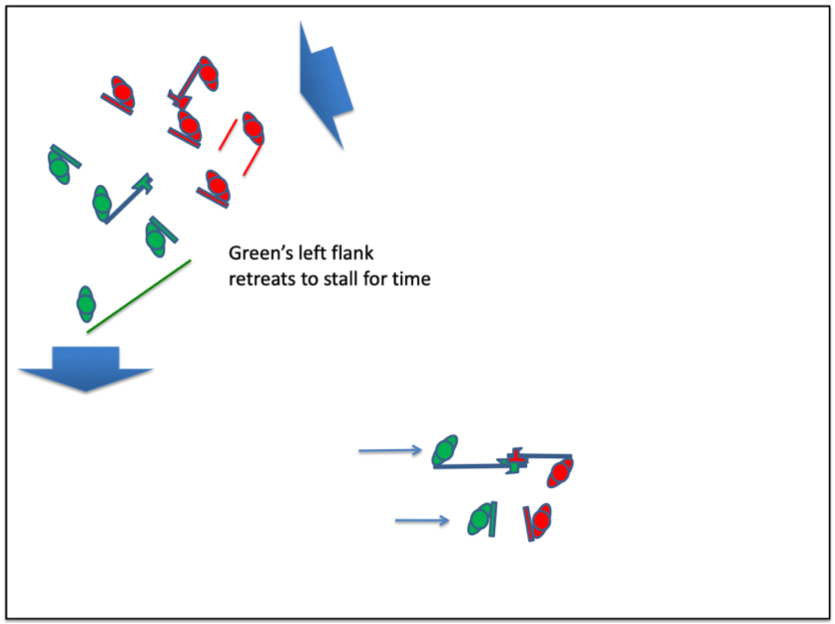
Let's revisit the setup picture.  Which team has the advantage with range weapons?


The green team has three long weapons compared to red's two long weapons.  Additionally, green's long weapons were longer (green had the only spear on the field plus the longest pole).  

Often times these fights will break down into some long weapons' dueling on either team, with the shields serving more of a support role.  Red had made the decision to push for an in your face engagement in order to neutralize the green team's long weapons, which I believe was the right decision and one that worked out well for them.  


Tactics Employed that Day

In every scenario, red was pretty aggressive at lay on.  They mostly attempted to either send all of the troops to the right, perform an attack right - deny left, or split up into two units on the edges of the field.

Green tried to get off ranged shots before the shields got into range.  If red went all in on their right, green would try to envelop.  If red left smaller numbers of fighters on their left, green would try to beat them quickly and then quickly rejoin the rest of its unit.  


Notes on Denying a Flank

Green struggled to secure the left flank.  Later in the day Sir Galvin helped with the flank and got them to do a nice retreat which allowed the right enough time to win its flank and then join up with the left.

Remember, denying the flank doesn't mean that you need to win the flank, only that you need to keep the flank from getting around you and into the backfield, and if you do lose, that you lose slowly.  A slow retreat can accomplish the same goal.  You'll note in the picture below that though red has pushed the flank back, it never really got around it.


Spear Movement

A question came up yesterday about spearing in this situation.  The bottom line is the spear needs to be very mobile and always have a good idea where the enemy is coming from.  It's a bad idea to let the enemy out of your sight for too long.  

As the swirling tidy bowl often forms, you end up with this kind of S shape on the field (if you aren't familiar, a lot of battles end up with a counter clockwise rotation on the field, has both teams tend to be stronger on their right flank, and weaker on their left flank due to the right handed nature of most shield fighters).  The spear needs to be careful not to get caught with the enemy coming behind and from the left.  Often the spear needs to move either to its right or left to prevent this from happening.


Notes on Center Position

When talking about the "center" position, I'm really talking about fighting in the eventual gap that forms once the units break.  I had a discussion last night with a veteran melee shieldman (Arundoor) and we both talked about how we prefer this position as it allows us to better influence the outcome of the battle.

Having said that, it is probably a position for a fighter of a certain level of experience/prowess.  Most fighters would likely feel more comfortable fighting within a smaller defined group of people (like a triad, or the center of a small group of 4 or 5 fighting on a flank).  Fighting the gap requires good field awareness and mobility.  


Observed Trends

One thing I've noticed over the last 7 years since I've really started paying attention to tactics is provided that both teams have at least one experienced competent melee fighter and have the flexibility to make adjustments (ie they were not instructed by someone to use a specific tactic), these battles almost always end up with each side splitting into a left unit and a right unit on both sides.

Many years ago, as I said in my last post, we were taught that the flanking maneuver was "the way" to win these battles.  Again, I agree that that is an effective tactic provided that the opponent doesn't know how to counter, and often times they don't.  Especially if you are at a big war and your opponents are a collection of fighters who don't usually fight together, and half of them haven't put on a helmet in months.

But when you have a group full of active fighters who are motivated, it doesn't usually take long for one side to figure out how to counter.  If you bunch up and charge right, we're going to see that and should be able to get behind you pretty easily ("should" is the operative word).

Side note to this:  There was a point in time when I thought that a collection of fighters should be able to figure this out on the fly.  Over the years, I've been in situations where the best tactic really was to put them together in a block and point them at something, as the average fighter on the field just did not have the experience to move and adapt well on the fly.


Some Notes on 2v2

We did some 2v2s yesterday and discussed some of our tactics afterward.  I believe everyone realized that ultimately the 2v2s were going to break down into two 1v1s.  One of the teams said that when they fought, they focused on how they wanted to match their fighters up against their opponents to give them the best odds of winning one of the 1v1 fights quickly.

Another tactic that was pointed out to me was since I was fighting with a pole and like to thrust on the oblique a lot, one of my opponents made it his job to pull me away from his teammate so that I would not be within thrusting range.

There are lots of little nuances like this that are endless, which is part of what makes this game so fun.


Thank You

Special thanks to Myq and the Barony of Carilion for organizing and hosting us, to Sir Ryu for marshaling, providing feedback, and keeping the crowd engaged, and to Sir Galvin for leading and motivating the melee fighters throughout the day.  And, of course, to everyone else who keeps coming to these practices to make them happen.  Right now this is, IMO, the best game in town!


THL Bari of Anglesey
East Kingdom


Friday, September 17, 2021

Small Teams Melee Decisions.

Unfortunately I showed up late to the last Southern Army regional melee practice, but I got a little feedback regarding the small teams work that some of the fighters were doing and wanted to outline here the decisions that the fighters should be, in my opinion, making on the field.


Executive Summary (TLDR)


Below I include a lot of details and diagrams building up from a 1v1 to 3v4.  Each case has some nuances, but I think there are some general themes that carry through each one and it would be helpful to read through each example.

Having said that, I think I can summarize some general principles up front.


Best Decisions (each one is a unique tactic):

     -Surrounding the enemy with all fighters engaged
     -Sticking together and amassing the unit around one flank
     -Spreading out and finding opportunities for mismatch kills (shield charges spear, 2v1, etc.)
     -Denying one flank while attacking the other

Which tactical decision you make depends entirely on making an educated guess at what mistakes your opponents may make.  For example, running at a flank may be a bad decision if the opponent counters with an envelopment plan and can prevent the flanking maneuver.  On the other hand, spreading out and finding mismatches won't work if the opponent is better at finding mismatches than you are.


Worst Decisions

     -Turtling up and taking it
     -Fighters not staying engaged
     -Spreading out with no ability to stay engaged (a disorganized mess)


No Single Tactic is Best

There is more than one right way to do something, but there are even more wrong ways.  What this means is to not get bogged down with the idea that there is a single right way to do something, yet each tactic is going to depend on both the capabilities of your team, and a good estimation of what the opposing team will do.  Understanding this will help you pick a good tactic.

Part of the motivation of this post dates back to a regional melee practice in 2015.   We were being taught "the way for smaller teams to engage larger teams."  The method was for the smaller team to stick together and charge at a flank in order to get a numbers advantage on the flank of the larger team.

This worked very well, but only because the larger team was taught to "stick together."  

To be clear, this is a very effective tactic IF the opposing team sticks together and isn't very mobile.  It's actually even more effective if the opposing team doesn't stick together, yet still isn't very mobile, both scenarios being very common.


So on that day two tactics were taught.  The first was for the larger team to avoid the disorganized mess shown above, which is an important lesson to learn as a lot of fighters at these practices mostly fight singles and are prone to wander the field waiting for a single fighter to approach them.

The second was, as I said above, for a group of fighters to charge at a flank.

What I was initially doing that day was a little more dynamic than what they were working on, and something that I had been doing with a fair amount of success for about a decade.  When ever a team sticks together, there is a strictly defined finite space that an opponent will be.  Knowing that, I can position myself anywhere on the field that is not in their kill zone.  So the tactic I was using could be loosely described as an envelopment.  (note, I was fighting with a spear, so a spear is pictured below)


The downside to this tactic is the the spear can be run down on the flank (but not if the other team is forced to stick together).  In the second diagram, sometimes the shields get confused because they aren't used to a pear in front of them, or the spear can get run down if he doesn't know how to quickly get behind his shields when the charge comes.


Risk vs Reward

The risk of teaching any of these alternative tactics is that a team of low level fighters won't know what to do.  The simplest tactic to learn is "always do this."  The more complicated tactics are when decisions have to be made on the fly.  

The reward is facilitating learning, creating more advanced fighters, increasing the overall average experience of the fighters on your team, and at a minimum, understanding what your opponent is doing if they are applying these different tactics even if you've opted not to.

In my opinion, the fighters who show up to practice are motivated fighters.  These are your future leaders.  My suggestion is to help them learn as much as they can.


Best Way to Learn

 Fight a lot.  Give them the opportunity to make decisions on their own.  Certainly teach them tactics, but I much prefer that this happens after they've been given ample opportunity to figure them out on their own.  

This is certainly nothing I'd ever done as a basketball coach, but in those days I had the same 12 team members practicing 2 hours a day.  I really believe that the circumstances of our sport lends itself to different methods of learning how people fight and what they are capable of.  You never know who's going to be on the field on a given day, so a certain degree of flexibility and improvisation is going to be needed.


The Worst Tactic

Or at least one of the worst.  I see this a lot.  Please, please, please stop doing this:

Read through the scenarios below to figure out what better options are, but turning your backs to each other really puts you into a bad position, yet it is so common (often pictured in movies, in fact).


Specific Nuances of Each Scenario

Below I'll be covering in a little more detail the following scenarios:

1v1
2v1
1v2
2v2
3v2
2v3
3v3
4v3
3v4

This progression is intended to show you how we can take basic concepts from any small team matchup and build on them toward the next team matchup.


1v1 - Best to Avoid

More often than not, you should avoid a 1v1 fight in a melee.  All things being equal, you have a 50% chance of winning this fight, and I truly believe that everyone who's cares enough to show up to melee practices and/or read this blog has more potential than looking for 50/50 odds. 

There are exceptions to this rule when:  


-  You are MUCH better than the person you are fighting and can kill them quickly with little risk
-  You have a weapons mismatch:
         You have a shield and they have a spear or bow and you can easily run them down
         You have a spear or bow and they have a shield or pole and you can take low risk shots
-  Your options are getting much worse as the battle progresses (ie 50/50 might be the best odds you'll see in the scenario)

2v1 - Forty Fives

The general tactic for a 2v1 is for one fighter to break slightly left of the opponent, and the other to break slightly right.  The biggest mistakes I've seen in a 2v1 is either one of the fighters stepping in front of his teammate, or one of the fighters not engaging, but rather just watching the fight.


1v2 - Line Them Up

Only fight a 1v2 as a last resort.  You should normally be looking for numbers advantages, not fighting when you are at a disadvantage.  

If you find yourself in a 2v1, try to get one of your opponents in the way of his teammate.  It's normally better to move to your right, especially if you have a shield, as you're moving away from right handed attacks, and in a direction that your shield can protect you.  However, the better maneuver is to figure out which opponent has the worse field awareness, and try to either get him in the way of his teammate, or move away from him hoping that he'll disengage from the fight.


2v2 - Forty Fives

Hopefully by now you're recognizing a pattern.  Surrounding your enemy is good.  Getting surrounded is bad.  This is especially important with a 2v2 as both opponents become a target once they're surrounded.  

This is also the most common problem I see with a 2v2.  So many lower level melee fighters are taught to "stick together" that they immediately put themselves into a very bad position when fighting a 2v2.  While sticking together is great to avoid the "Drag Out a 1v1" shown above, it's not always the most effective tactic.  Breaking off into two 1v1s is better than getting surrounded.


3v2 - Keep Them Surrounded

Same as above.  When you have more people, you normally want to surround your enemy if you can.  Once the units start to get bigger, the keys are to make sure that you avoid 1v1 fights and take advantage of 2v1 opportunities.  Don't let your opponent get around either flank, and make sure that all of your fighters are engaged.


2v3 - Hit a Flank, or Spread Out & Find the Mismatches

In the 1v2 fight, you had two choices;  move to attack one flank and hope that you can get one of the opponents in the way of the other opponent, or that the other opponent would be slow to stay engaged.  The other choice was to try to draw out one one of the opponents into a 1v1 fight while, again, the other would be slow to stay engaged.  

In many of these smaller team versus larger team fights, you have the choice between sticking together and moving at one flank, or spreading out and trying to find mismatches and fights with better odds.  The better tactic is often going to depend on what you think your opponent is going to do.  

To visualize this, look at the diagram above and imagine yourself fighting on the red team.  Here your goal is to try to get the green team to use a bad tactics.  Can you surround them because they are focussing on sticking together without moving?  Can you get around one of their flanks?  Can you draw out a 1v1 while stalling for time in your 1v2?  Or on your 1v2 side, can you employ the 1v2 tactics shown higher in this post?  (line them up, or drag out a 1v1).


3v3 - Hit a Flank, Spread Out & Find the Mismatches, Envelop

As the numbers get bigger and bigger on each side, weapons styles, unit type, etc. become more and more important when determining what tactics to use.  Who has the spears?  Where's the archers?  Are you big and strong, or small and fast?  Do you have a mix of uber veterans and newbs, or all mid level fighters?

Nevertheless, better tactics tend to be to either move quickly as a unit to one flank, spread out and see if you can find some mismatches to take advantage of (your shield versus their spear?  Your veteran versus their newb?  Two of you versus one of them?), or to envelop the other side if they turtle up and take it.

The worst thing you can do is to turtle up and take it, which unfortunately one of the most common tactics used.


Here's an example of an actual 3v3 that I fought once.  Both teams had two shields and a spear.  The opposing team did exactly what you'd see in a movie, and what is often used in the SCA.  They formed a tight little shield wall in the front and put their spear behind it.  Our team surrounded them and picked them off fairly easily (this ALWAYS happens).  Eventually in the following battles, their team spread out to match our team, and both teams began using the "spread out and find the mismatches" tactic.


4v3 - Keep them Surrounded

Tactically this isn't much different than a 3v2.  Again, keep in mind that the larger these fights get, the more other factors come into play.  One of the big things I've been addressing lately is the idea that most small engagements come down to quick decision making regarding which side has the range advantage.  I've not really been addressing that in these examples, other than to point out clear mismatches.

Look at the 3v2 diagrams and employ all of the same principles.  Try to keep them surrounded.  Don't let anyone get around your flank.  Make sure all fighters stay engaged in the fight.  If things get spread out, look for the mismatches (shield vs spear.  2v1.  Veteran vs newb.  etc.).

3v4 - Denying a Flank as an Option

Once you've reached this size I believe the smaller team now has the numbers to deal with both flanks.  The same options as before are still available:

- Surround the enemy if it looks like they are going to stand in a tight group without moving
- Spread out and find mismatches if you see opportunities
- Go hard at one flank if it looks like they'll let you get around it without staying engaged on the opposite flank

Additionally you can peal off smaller numbers of fighters (in this case, a single fighter) to attempt to deny to opposite flank from enveloping your fighters.


Note, in this case the loan denier's job is to prevent the flank from enveloping.  He or she does not need to fight a 2v1, but rather keep them from wanting to turn the corner and exposing their flanks to this loan fighter.  If they do, then go ahead and kill them (it happens way more often than you'd expect).


Final Thoughts

This covers most of what I wanted to cover.  One last thought to keep in mind is that it is generally better to form an arc than a bulge.  Be the team that is surrounding the fight, not the one that is being surrounded.  If you decided to spread out and find the mismatches, make sure you can see all of the other fighters on the field, and place their backs to the fighting.


Hope you enjoyed!  Have fun.  Fight safe.


Thursday, July 15, 2021

Southern Army Sunday - July 2021 - Small Teams Field Battles and Bridges

 Man, it's great to be back to doing melees!  The heat and humidity weren't bad, and considering we haven't had a spring season to get us in shape,  I think everyone had a great time.  Best guess was we had maybe 35 fighters in total.  I just want to run through some thoughts I had during and after the fights.

10v10 Field Battles

We started off being split into three teams.  Two teams fought while one team watched/rested.  I was put onto a team with a bunch of fighters that I'm not used to working with, which was a good experience to have.  Within our group I would say that we had three "uber veterans" between myself, Sir Galvin, and Morde (not a single non-gray hair between us) and a lot of the planning and leadership came through us.  

We were given very little time to plan (again, great experience).  Normally I fight with a spear, but each of the other two teams had two veteran spears to just our one spear, so I opted to fight with a pole arm.

Assessing the Range Advantage

Whenever two opposing sides meet, one needs to always asses the range advantage and then develop a quick tactic based off of which side has range weapon superiority.  If the other side has spears/archers and you don't, you NEED to charge (unless you are a small piece of a larger battle,  in which case you may retreat or stall).

For our team, we decided to concede the range advantage altogether and build a charging team (in other words, instead of fighting 1 spear vs 2, we went with 0 spears, giving us an extra close range weapon).  Our tactics for most fights were two take a 3-4 man shield wall, and run it hard to the right, while I sat wide on the left flank with a pole.

Controlling the Flanks

Always have a plan for controlling your flanks.  A collapsed flank often leads to a quick death to your team.  With our plan for a hard charge to the right, I saw two ways that we can control our flanks.  Provided that the charge was hard enough, our right flank would be protected simply by sending a mass of fighters to the right, either getting outside of their left flank, or by having numerical superiority on their left flank.  

The left is protected either by running away from their right flank, or by leaving a floater on our left for them to have to contend with.

My concern with the first option was that the other teams had aggressive mobile spears and poles with lots of melee experience, and I was afraid that they'd chew up our left flank as we ran to the right.  


This can be countered with option 2, which actually worked very well in at least one of the battles.  


In the final scenario, we were met with a team that controlled their flanks better than we did.  I honestly think we were outgunned, so I don't know if we could have won anyway, but we still made some mistakes that I'll touch on later.

Having said that, this team went with two knights, both solid, quick melee fighters with shields, and they covered each flank and attacked aggressively.  I believe Sir Sterling yelled, "Sir Klaus, I'll go left, you go right, and we'll meet in the middle!"

Klaus took me out of the fight, not by killing me, but simply by running up that flank and preventing me from attacking their right flank.  He then turned back into the fight before I could, and by that point they had secured victory.


Doing What You Do Best

There were a couple of scenarios where our team didn't do as well as we'd hoped, and in some cases it was attributed to coming up with a plan that the team (which was a collection of fighters with little experience working together) was not really prepared to handle.

In one example we faced a team with more shields than us and were expecting a charge.  I called for a kill pocket and explained that we needed a shield to cover each extreme flank by going really wide.  It didn't work well because the shields were not used to this tactic, I didn't explain it well, and it's unlikely that even if I had, that they would have been able to execute something that they were not used to.


Now I can sit here and explain what every person on our team did "wrong," but ultimately the failure was in coming up with a plan that the team was not collectively able to execute.  So the failure fell on me.


Revisiting the "lets meet in the middle" scenario above, after the fight Sir Galvin (a teammate) approached me and said, "I'm not really a middle of the shield wall kind of fighter.  I usually do much better if I'm out on a flank with a lot more flexibility."  Once I heard it, it made a lot of sense.  The whole day we were hurting ourselves by removing one of our talents with him in a position where he couldn't use all of his skills.  Maybe it would have been better for him to take one flank, and myself to take the other, much like the red team did in the "meet in the middle" scenario?  Could we have pulled off the kill pocket if I went far left and he went far right, and we told everyone else to fill in in between?

Another critical mistake was made in the "meet in the middle" scenario.  I planned a shield wall charge to the right.  Red then redeployed one of their knights, and their spears moved into a different position.  I then changed the plan to "charge left," and then called the charge after lay on.  The shield wall began the charge, but then froze in the confusion.  


In hindsight, I think we would have faired much better if we just stuck with the original plan and executed it to the best of our ability.

Sir Ryu showed us a technique that assists shield wall charges, which is to have a pole fighter stand behind the shield wall, hold the weapon horizontally, and place it across their backs.  The pole fighter can then gently steer the shield fighters by gently pushing one side or the other forward.  When the charge is called, a little more pressure can be applied to get the wall to charge together.

 I've seen him do this before, and it is a very effective technique.  Are there any problems with it?  Well, he's very much a "middle of the unit, behind the shields" kind of fighter, where I'm more of a flanker.  So this goes back to taking a talent out of position to perform a different task.  

I'm not sure what the best answer would have been, other than to have done something other than what we did.  Go with two veteran flankers?  Stick with a shield wall charge to the right?  Pull a flanker out and have him guide the charge from behind?

Effective Reforms

Reforms are important, but they must be done effectively.  Reforms can also, in some cases, hurt your team.

There was an instance where I felt like I was facing a 1v4.  Usually this spells doom for the team that I'm on, because if I'm facing 4 fighters, that means that they're probably up on numbers at this point.  I looked around and saw a bunch of my teammates disorganized and not really engaged with anyone, so I called a reform.  "Yellow team, reform!  Yellow team, reform!"  As it turned out, the opponents were also in the middle of reforming.  Once reforms were complete, we had the bigger team.

Under normal circumstances, I think the opponent should have taken advantage of a small localized numerical superiority rather than call a reform.

Looking at the picture below, the green  team needs to call a reform.  The red team, on the other hand, has a clear advantage on its left flank, and should take out the green team in several 3v1 fights before the reform is called.


This is also true when there is a range weapon mismatch. 


In the above case, again, red should not call a reform but, instead, take out the spears before they get support.

Caveat:  We discussed this after the battle and realized that the reform was called because one of the shields had lost an arm.  Additionally, I was their target and even though I couldn't beat the three of them, I'm fast on my feet and the fight would have likely tired all three fighters out.  It may have also tired myself out, but that's one tired fighter on our team in exchange for three tired fighters on their team.


Bridge Battles

I don't have much to say about these, other than that they were fun, which is the most important piece.  The other team had Vlad Iliescu commanding, and he did a fantastic job.  There were a few instances where we thought he should have called a charge, but he didn't because he wanted to give our team a chance to fight.  Sometimes this happens in a practice, or a war where winning isn't nearly as important as making sure everyone is having fun.  They had easily pushed us off of the back of our bridge, effectively establishing that they were the better team.  There was no need to fight us at our rez point, demoralizing us, and maybe making people want to quit fighting for the day.

Likewise, in another bridge battle, we had an archer on our team while they did not.  The best strategy is to form a kill pocket at the end of our bridge and shoot at them.  They might, however, respond by standing off the back edge of their bridge and waiting until the archer runs out of ammo.  We counter by not firing any arrows until they come closer.

Everyone loses due to boredom.

As a general rule, I like to meet in the middle and fight it out instead of capping the bridge.  Which ever team gets pushed back to their side of the bridge is the effective "loser."  They can save face by trying to neutralize their opponent by pulling them into a kill pocket at the end of the bridge, only after they've lost the battle for the middle.   Everyone gets to fight.  Everyone gets better.  It's a win win provided that the commanders know how to utilize the best tactics when it's important.

Again, it's not the best tactic for winning the battle, but it's a more fun way to fight for everyone involved.  I've been in battles where both sides decide to cap their end of the bridge and refuse to engage hoping that the opponent will give in and walk across the bridge and into the kill pocket.  We stood their for an eternity, and everyone hated it.

Thoughts for Alternate Bridge Battle Rules in Practice

I find that training for bigger bridge battles with small numbers to be a bit of a challenge as a small bridge (meaning 10-15 people on a side) and a large bridge (50-150 people on a side) are very different battles.  In my opinion, one of the main keys to winning the large bridge battles is organization.  Mainly this revolves around the balance between spear fighting on the front line,  charging and counter charging with your shields, and the transition between the two.  That's very hard to replicate with small numbers.

We often try to do this by throwing in 3 lives per fighter, hoping that a 15v15 might feel more like a 45v45.  What ends up happening is that it feels more like a longer lasting version of an 8v8 because of the constant flow of fighters to and from the resurrection point.

I'm wondering if maybe this could improved by calling periodic short holds, just enough to allow the dead fighters to return to the front so that the numbers can be bolstered back up to 15v15.  I might be completely wrong on this.  This might be a terrible idea because, as we know, everyone hates a hold.

I also think it would be beneficial for dead fighters to actually fall dead in the middle of the bridge so that we can practice fighting over them.  But who wants to do that in 90 degree heat during practice?

Final Thoughts on What We Hope to Accomplish

I've said this a couple of times already.  We aren't going to effectively train 100 fighters in a region when 25 show up to practice. but what we can do is train commanders, sergeants, mini-sergeants, future commanders, etc.  as well as increasing the density of effective fighters within the region.

In other words, instead of a goal of making everyone able to follow incredibly simple commands, like walking in a line while sticking together (not that there's anything wrong with it) I think we should help make the people who show up to practice into the best fighters and leaders that they are capable of being, and then give those who don't show up to practice good role models to follow on the field at war.  

I think this is the direction that we've been going in and I like it.


Wednesday, June 16, 2021

Communication, Organization, and Aggression - Sometimes Less is More


 We just finished up two small melee practices in the East Kingdom Southern Region over the last two weekends.  I really enjoyed them and appreciated everyone who made it out in these crazy times.  I should open up by stating that often times in these blogs I nitpick on the failures instead of the successes.  There were lots and lots of great successes at these practices, from all levels of people who participated, including the newest fighters, to the uber-veterans, knights, commanders, and royalty.  I think every last person made some real positive contributions, and am very pleased with the effort and enthusiasm that everyone brought.

Having said that, I've been fighting as a melee specialist for almost three decades, in a melee household, with an additional background as a basketball coach and hockey player, and I may be a bit blunt at times when I see things that I don't like, some of which I'll illustrate below.

TLDR:

-Sometimes lots of little short bites of communication needs to occur (small teams skirmish)
-Sometimes everyone needs to all yell at the same time (getting a big unit to rush an objective)
-Sometimes a small number of commanders need to yell very clear commands (organization on a bridge battle)
-Sometimes deliberate organization is needed (shield wall.  bridge battle)
-Sometimes less organization is better (small teams skirmish)
-Aggression at the right moment is key (you have a 30v20)
-Aggression at the wrong moment will lose you the battle (you have mostly spears, but you call an aggressive charge against a unit of shields)


Capture the Flag

These are my absolute favorite for drilling melee tactics with small numbers of fighters.  These allow the most opportunity for a small group of fighters to get together to workout tactics, make mistakes, identify and fix them on their own, and to find successes.

Two weekends ago we fought 7v7 in a broken pass that looked a bit like this:


If you died, you went to a resurrection corral which would let out every 30 seconds.  On either side was a flag for the other team to try to capture.

In this scenario, we ran it over and over and over again, each side making small adjustments as they started to figure the other side out, much like a basketball or football team would throughout the course of a game.

One example was when the King of the East noticed that I was controlling the middle of the pass with my spear, but had no backup.  For two scenarios in a row, he set up across from me and then jumped me, which caused our side to collapse as I had no one to support me.  This was tough as we only had two shields, and felt that we needed them to control the two flanks.  We also tried a few times to press hard on the right, which meant that we'd be weak on the left.  That worked a couple of times, but the other team adjusted.

Ultimately we discovered that the red team was better at charging, and we were better and countering.  There were several scenarios where red would charge up the right flank, and green would fall back and get them into a kill pocket.  Sometimes red made it all the way to the flag and would win.  Other times, green would pick apart red as they worked their way through the kill pocket.  If green could kill all of red, they could then run across the field and grab the flag before the dead re-spawned.

This past weekend we fought similar battles with similar results.  Both teams lined up across from each other and tried to find a weakness to exploit in the other side.  Someone would win.  Both teams would work it out among themselves and then make adjustments.

Communication

One of the knights observing had mentioned that we were not communicating when fighting as he didn't hear us talking.

Now I won't doubt that the communication could have been improved, and I'm certain that some people probably weren't communicating at all, but talking while fighting is more than a box that should be checked off to keep the pointy haired manager off of your back.  It needs to be appropriate and effective communication.  One of my friends has said, "If the knights are watching, I'll just randomly call a reform for no reason, and they always compliment me in front of everyone, because they have no idea if we should have reformed or not.  They just think that calling reforms is evidence of good communication."

I had a conversation with a friend last night who played a lot of hockey when he was younger, and he currently coaches his son's team and is a professional educator.  "Yes, kids need to learn to talk, but it's usually short, simple ideas, and centered around simply making sure they they aren't both doing the same thing.  Saying, 'I'll get the puck,' or, 'cut to the net,' are examples of good communication.  There's no way that you can communicate a complicated plan in the middle of a game when the guy on the other team is trying to check you into the boards." This is consistent with my background on the subject.

The reason why I bring this up is that two examples of communication were brought up by observers that were good examples, but inappropriate to the situation.

We tried something different in one scenario.  One person  yelled and commands loudly and enthusiastically throughout the 2-3 minutes of fighting.  Though it was meant to be helpful, it drowned out any opportunities for us to communicate useful information to each other.  It was also distracting because I can't look for kill opportunities and also process what someone is saying at the same time, and eventually it got tuned out completely.  There was one point where I was completely exposed on a flank and needed to bail.  I wanted to tell my team to fall back to the rez point, but they would not have heard me.  I'd also like to note that, historically, I get a lot of kills by stabbing whomever starts talking.  Most people can't talk and fight at the same time.

FWIW, I did exactly the same thing when I was first put in charge of a unit many years ago, and received similar critique.

This kind of communication is perfect for a Pennsic field battle where you've decided (hopefully correctly) that you need to move a large set of troops through an enemy unit quickly and aggressively.  In this case, there isn't any person to person communicating necessary, you just need to ramp up everyone's aggression and to get them to execute a simple task (move forward and swing hard).  "GO!  GO!  GO!  DON'T STOP!  KEEP MOVING!!!" is very effective here.

Another example given by an observer was to tell your teammate, "Hey, I'm going to attack this guy low, you attack him high."  This works in static battles where everyone is tired.  In faster moving battles, communication needs to be short and simple.  "45s!"  "Pin his spear!"  "Jump him, now!"  "Lets get him!"  There just isn't enough time to communicate ideas more complicated than these.

Organization

 I've found that so few scadians have a team sports background, and of the ones who do, many come from football, which is a unique sport that allows for a lot of organization to occur between the plays.  I honestly believe that if you let a scadian coach basketball, hockey, lacrosse, soccer, or ultimate frisbee, they'd try to group the players into blocks and have them march around the field while following basic commands.

The sports I listed above are more skirmish oriented.  Players are expected to understand basic fundamental jobs rather than to follow rules or wait for commands (though commands do have their time and place, which is why they have sideline coaches).  

Which of these two pictures is the better organized group?


If you were a scadian walking in on a practice and didn't really know what you were looking at, you might be much happier if you saw them fighting like the second group.

The first picture is actually a screen shot of a professional basketball game.


Now this doesn't mean that scadians should adapt professional basketball offenses to their tactics.  I'm only trying to illustrate the point that just because something doesn't appear to be organized to the untrained eye doesn't mean that micromanaging your team into something with symmetry is going to help.

At one point during the fighting last weekend, it was suggested that we pair up.  I call this the "buddy system."  Some kingdoms try something similar with "triads."  While I think the buddy system is great for brand new fighters who are just completely lost on the field, I have two big problems with it:

1)  Jobs need to be done on the field.  A fighter's job is not to "fight next to Johan."  It's to run down a loan spear, plug a hole, secure a flank, double team a fighter, stab someone, stop a threat, call a retreat, etc.  Once you've adopted a buddy system, jobs are left undone. 

2)  You've now taken all of the complexity out of fighting and simplified it to "find Johan."  A fighter will never learn how to fight if they aren't given the flexibility to make decisions on the field.  Yes, they'll make mistakes.  They'll make bad decisions.  But they will never learn if you don't give them the opportunity.


Aggression

I heard several times over the last two weeks that the side that more aggressively took the initiative was the side that won.

I don't fully agree.  In fact, as I said above, green had won several battles by getting red to charge into a kill pocket.

Level 1 fighters have no aggression and die with the "deer in the headlights" look.
Level 2 fighters learn aggression.
Beyond that, you need to learn when and where to apply aggression.  If you are facing a 10v20 as part of a field battle, the 10 better not try charging right into the unit of 20.

The first step is finding where your advantage is, and then aggressively seizing that initiative.  Sometimes aggression and initiative are key, but sometimes it's better to wait.


My Approach to Teaching/Learning in Melee Practices

I said to the kingdom commander last week, "You aren't going to train an army when only 15 guys show up to practice, but you can train leaders."  All the people who don't show up to practice?  They're the ones who won't know what to do.  They're the ones who need buddies.  They're the two people in the triad following the one who knows what to do.  They're the ones who need to learn to be aggressive and follow commands.

But each and every one of the 15 who did show up need to be allowed to make most of their decisions on their own, with a bit of guidance from veterans.

Every scenario that we run at a practice, I let the first one go without saying anything to my team.  One of the best teachers is losing to disorganization.  Then as each scenario goes by, we get together and discuss, as a team, what changes need to be made.  Keep in mind, I don't have all of the answers at the beginning, either.  I'm also learning as we go.  Just because I'm the guy writing this blog doesn't mean I have the best ideas on the field.

Then when we pop our helmets, we get together in a group and discuss what we learned, what we thought worked, what didn't work, what we should have done differently, etc.  While telling a fighter to "do it this way," may be very effective in the knight/squire relationship when it comes to singles, I really think that more flexibility needs to be allowed in melee practice.


Monday, June 7, 2021

Southern Region War Camp Pt1 - Moving Spears and Shields Past Each Other

 It was great to be back! This was the first official SCA event I'd attended in over a year.  It was hot, we were out of shape, and the masks were difficult to breathe in.  But we persevered!

I'll cut to the meat of what I think is a key piece that we, and likely most scadians, need to work on regarding melee in static battles (part 2 will talk to the rest of the day)

Author's Note:

I'm about to address three areas with room for improvement.  I want to note first and foremost that there is always room for improvement with every group of fighters.   Having said that, I was really impressed with the group that we had on the field yesterday and thought everyone did a fantastic job fighting and I look forward to a year with many more well fought events!

Moving Spears and Shields Past Each Other

Consider a basic bridge battle.  In our case we had a very narrow bridge, maybe 7 feet wide, with about 10 or so fighters per side.  I almost always want to begin this scenario with a shield wall at the front.  More often than not, our opponent does the same, and we both march across the bridge and meet in the middle.


In most bridge battles I've seen, one or both sides will bring their spears to the front, and the spears will work for a while trying to get as many kills as they can.  At some point, one of the two sides decides that either a) they are losing the spear duels or b) they spot a weakness that can be exploited by a charge (like the opponent has spears in the 2nd rank).


Think of it like a mixed marshal arts fight.  Standing up, punching and kicking, is like fighting with spears in the front.  Charging at the opponent in an attempt to grab him and throw him to the ground is like a shield charge.  Most MMA fights start with both opponents striking, until one opponent decides that their odds would improve if they charged their opponent.  In this instance, both opponents need to be trained not just for striking, and grappling (the grabbing part), but also the transition between the two (one wants to initiate the grapple, the other needs to avoid being dumped on their head).


What I found while fighting were three areas in need of improvement:

1-Communication (Spears Talking to Shields)
2-Keeping Spears Off the 2nd Rank
3-Spacing the Spears


Communication:  A Lack of Assertiveness and Communication from the Spears

At some point a commander should (and will) yell with a commanding voice, "Spears to the front!" or "Spears up!" or "Let the the spears up!"

Shields in the front rank never respond to these commands because they aren't spears, and they feel a sense of duty to hold their ground when standing directly across from the enemy.  Additionally, they cannot take their eyes off of what's in front of them or they'll get killed, so they have no way of knowing what is coming up behind them.

What needs to happen is that as a spear comes to the front line, they need to be very assertive, and very vocal about what they want to do.  This does not come naturally for a lot of people, but it is necessary.  

Begin by sticking the point of the spear well past the shield fighter who's spot you wish to take.  This is necessary in order for them to know that there's a spear coming up, because they can't look behind them.  You then have to say something loudly to let them know what you want to do, and you have to identify them in some manner so that they know that you are talking to them and not one of the other 30 people within ear shot.

"Hey Roman guy, can I have your spot?"
"Magnus, I'm coming up behind you with a spear."
"His Majesty, may I please stand in front of you with my spear?"
"Guys, I'm coming up with a spear (tap tap tap) M'lady, I'm coming up on your left (tap tap tap)."

And when you get almost up to the front rank, don't be afraid to do a bit of shoving and jostling to get your spot.  As long as everyone knows that the command has been given for spears to replace shields, this shouldn't be an issue.

Below is a short video that models exactly how this is done (the whole video is valuable, but this particular part is at 1:19):


Keeping Speers Off the 2nd Rank

Another problem I noticed was spears who don't fit on the front line would crowd up the second rank.  This is very bad, especially if there's any reason to hold ground on the bridge.  Any time I see an opponent with spears in the front rank AND the second rank, I immediately call a charge.

A spear in the second rank is completely useless when the spears are in the front.  The fight is 9 feet away from the front rank, which means it's 12 feet away from the second rank.  There's nothing you can stab.  You're just an obstacle preventing your own shields from being able to get into action when needed (when the charge occurs).  


Bad Spacing of the Spears

Spears need to be spread out.  Though arguments can be made for the value of an anchor on the flank of a bridge, make sure you have a good reason to put an anchor there (guarding a flag?) and a good person to have in that position (someone who's really good at pulsing in and out, or throwing people off of bridges).

I personally like to have one spear at each extreme flank on the bridge, with spears evenly spaced between.


Notice below how the spear to the right side of the picture moved out to get a good kill angle on the two of us on the left (photo from a 2v2 fight 1 week ago before the Southern Region War Camp).


Final Thoughts

As I've finished writing this blog, I thought "what could I have done better?"

I was in command at some points.  We could have started the battle with a quick prep on what the tactics are.  I could have shouted very clear instructions, like, "Spears to the front!  We want exactly THREE spears on the front line.  NO SHIELDS should be on the front line!  If you have a spear, and you are not on the front line, then fall to the back rank!  You'll get your chance to fight.  Angus, tell Johan to fall back.  He's got a spear and should not be in the front rank."

I'm also hoping that in future practices we can work a bit more on this coordination.

One thing I expressed to those at the practice is that you can't train an entire region of fighters at a practice with 20.  The real value is for commanders to learn how fighters will naturally behave, and to figure out how to command them in the moment.  We also need to get all 20 fighters at the practice not just to be able to model good fighting at war, but to be able to translate these same ideas to those on the field who need to be taught in the moment.  Remember, there's a difference between what you can accomplish with a group of people who practice together daily, and a group of people who will never be able to practice together with any regularity.

Please see my blog post on bridge battle (it's quite nice!)

https://thetacticalfighter.blogspot.com/2019/10/baris-bridge-battles.html