Wednesday, August 17, 2022

Pennsic 49 - Field Battle

 Hi all,

Hope you had fun and either avoided the plague or are recovering quickly from it.

I've got a few thoughts to share regarding the Pennsic field battles, all from the perspective of where I was fighting on the field each time.

Ultimately, there's always an overall strategy that is put together by the warlord and the general.  Most of us have little control over that, but what we can do is do our job in making good decisions on the field and hope that it helps our side win the overall fight.  The best thing you can do is to kill quickly, die slowly, and and reform and move.  All of this hinges on putting yourself in a good position on the field and making good decisions.

Field Battle 1:

I fought with a spear heavy East Kingdom unit.  We were actually fairly well balanced across the unit, but separated into houses, which left the part of the unit I was in very spear heavy.  What this generally means is that we should be able to move quickly as a mob and get a lot of kills, but are susceptible to charges from the enemy.  These charges can be survived, but not without giving ground.

We were on the East's extreme right flank and moved quickly.  Moving quickly allows a unit to get into the position that they want.  The danger, however, is that undisciplined units tend to plow into their opponents without proper support because they moved into position faster than their supporting troops.

In this case, we were able to gain a really good flanking advantage on Dark Moon by running hard to our right as they marched forward.

Note:  in all diagrams, I'm taking a guess as to what it looked like from memory.  The further away from my unit, the more I'm guessing.


Once we got into position, I saw that they really didn't have the capacity to keep us out of their backfield, so I yelled, "Shift right!  Shift right!" followed by, "Let's curl this line.  Keep curling this line!"  The only thing I would have done differently would have been to call for more aggression in order to finish the fight sooner so that we could move on to other targets.  

You can see below the advantageous position that we were in.


I died before the engagement was resolved, but I know our side won the battle and I'm pretty sure we won this engagement.  My apologies if I remember it incorrectly, but if we lost, it was either due to a difference in skill, or having another unit come to support.  Regardless, I was pretty happy with the position that we put ourselves in.

Field Battle 2:

We were instructed to do something very similar for the 2nd battle, but after our general left, we saw a unit shift to the flank.


I think this was a pretty smart move.  Personally, I think you should never give up a flank unless you have some grand plan that can compensate for it.  They effectively had their soldiers on the out of bounds line with no way for us to go around.

Despite our orders, we knew that we had a 0% chance of getting around the flank.  Furthermore, we knew that we were facing a unit who could just run us over.  Sir Klaus, Sir Donnan, and myself had a quick conversation and agreed that we needed to "deny" the flank in this fight, and hope that where ever that new flank unit came from was going to leave a hole somewhere else on the field that other troops on our side could exploit.  We told our unit, "your number 1 goal is to stay alive, even if that means to turn around and run away."


We kept moving backward to avoid the fight, while the opposing unit kept marching forward.  It was actually easy to avoid the fight because larger units tend to move slow in order to maintain unit cohesion.  Notice the spread out nature of the blue spear unit.  The faster, more confident fighters end up in the front because they know that they can easily run away.  The slower, less experienced, or more timid fighters stay in the back to give themselves more room and time to react.  

At some point reinforcements came up behind us and told us to engage, which we did as we then knew that we had the support that we needed for the fight.

Uncoordinated Charges

It's quite common at Pennsic to receive uncoordinated charges from the enemy.  Militia units simply don't have the time to train their troops and the commanders don't have the practice to know how to get a unit to work cohesively.  Uncoordinated charges into a unit of spears often does not end well for them.


Field Battles 2-5:

For the last three battles I moved over to the left flank to fight with Anglesey.  Our unit was of a similar makeup as the East Kingdom unit I fought with on the right flank, but a little bit more cohesive only because we have more experience together.  In each of the three battles we pretty much found ourselves in a gap between two large units where we had the option to turn on either flank.  We always chose to turn left as we'd like to clean up a flank at the top of the hill, and then move the survivors down the hill, coming from the outside and moving in, with an uphill advantage.

Because of our small size, the larger units tended to ignore us, allowing us to get to a flank.


I did make one significant mistake.  After cleaning up the left flank, I headed quickly back down the hill, but the next thing I knew, I was surrounded by our enemy.  I had apparently outrun my allies who were still on the top of the hill.  I had underestimated how long it would take them to reform and get back into the fight.  In the future I will need to really take my time and make sure that I can pull a large unit of fighters together before heading into the next fight.


Getting Out of a Bad Situation

In the 5th battle, a bunch of people switched sides, which gave the opponent a stronger army than they had in the first four battles.  At one point, we found ourselves getting surrounded by a large unit.


Ultimately this was an unwinnable situation, but it's still our goal to make the best of it and hope that someone on our team is doing better elsewhere on the field.

Two parts of our units made different decisions, both of which worked to our advantage to help slow the bleeding.  The fighters to the extreme left of our line were able to run around red's flank, while some of the fighters in the middle were able to punch through a weakness in red's line.

This got us into the backfield, but ultimately the fight was lost.


These were just a few insights from the field battle this year.  Look for more to be posted in the coming days.


Thanks for reading!

Sir Bari of Anglesey - East Kingdom


Thursday, May 5, 2022

Melee Practice: Scrimmages, Drills, and Lectures

Introduction

Hello everyone, I'm THL Bari of Anglesey, squire to Sir William MacCrimmon, and one of the Lt Commanders for the East Kingdom.  I've got decades of experience fighting and running melee practices in addition to a former career as a high school teacher and basketball coach.  (Also, welcome to my 113th melee blog post!)

In this post I'm going to talk about methods of instruction, the scrimmage, the drill, and the lecture, and which methods are most useful for different kinds of situations.  In short, sometimes you need to let people figure stuff out on their own, while other times that can be just too overwhelming for them.


Academy Award Winning Lectures

Walk into a school and observe a bunch of classrooms.   The first door you open reveals an exciting teacher in the front of the room telling a story about the Battle of Gettysburg.  The second door reveals a teacher saying, "Nine times seven," and the class repeats in unison, "Sixty Three."  "Eight times four."  "Thirty Two."  And then you reach the third door and see a room full of kids with pencils in their hands scribbling onto paper with a teacher just watching.  Every now and then the teacher will lean into a kid and say something that you can't quite make out.

The first room revealed an example of a lecture.
The second was an example of drills.
The third was an example of guided practice.

Robin Williams was nominated for an Academy Award for Best Actor in the movie Dead Poet Society.  It was a movie full of scenes of him performing in front of a class, giving inspirational speeches, engaging students, getting them to think outside of the box, all while standing on top of his desk.  


Would he have been nominated if he just walked around the room and occasionally leaned in and said, "Bill, you forgot to carry the one."  

All three rooms revealed examples of teaching.  However, as scadians, we've dedicated ourselves to a hobby which is centered around living in an alternate universe that we've created.  We are, in a sense, thespians, and there's nothing exciting about watching our protagonist quietly standing off to the side and and allowing his or her class to work stuff out on their own.  Williams would never have been nominated for that!

But it is still an important component of effective teaching.


The Optics of Teaching

The incentive for writing this post is that I've noticed from many different fighters a lack of understanding of the value of a scrimmage.  For those not aware, a scrimmage is "practice play between two squads."  There's this perception that if you are lecturing or running drills, then you are teaching.  You know.....you're putting on the big performance, and everyone can see the teaching and the learning allegedly taking place.  On the other hand, if a scrimmage is taking place, there is no performance by our protagonist, and there is no organized act put on by the students to signal to the audience, "Hey look, we are involved in a lesson."  Despite its immense value, it doesn't LOOK like teaching, and I've noticed that sometimes teachers are afraid to just let their students fight.


Lectures, Drills, and the Value of Scrimmage

Let's take a simple melee concept that, here in the East, we call "forty-fives."  When you have a 2v1 situation, the team of two should split, slightly, so that each fighter is attacking on an angle to get around their opponent's shield.


Do you understand the concept?  I hope so, as I just communicated it to you through expository writing.  If we were in person, I would have explained this to a group in a lecture format.  In other words, the above was an example of the value of a lecture.

Now we can drill it.  I can get a couple of lines of fighters going and have them attempt in engage a single enemy with this concept.  This can be done in armor, out of armor, with weapons, without weapons, half speed, full speed, no contact, light contact, full contact, etc.


And then finally, we can test it in a scrimmage.  In this case, we can run an 8v8 field battle and keep an eye out for whether or not people apply the technique within the context of a battle.


So the concept of 45s can be taught via lecture, through a series of drills, and within the context of a battle.  There is an art to understanding when to use each teaching technique, how much time to spend on it, and which groups of fighters will benefit more from one method versus another.  Some techniques, like running away from a legged fighter, don't need to be drilled at all (people already know how to run away) and only minimal time is needed to really explain the concept.  This is definitely an example of something that can only really be learned through repetition during a scrimmage.  


Lessons From a Basketball Practice

A long time ago a lightbulb went off during a basketball practice.   My athletes were not "boxing out," after someone shot the ball (a technique used to put a player in position to get the rebound if the shot was missed).  Despite running numerous drills to improve the technique, no one would use it during the scrimmage.


I eventually realized that the problem wasn't a lack of skill and technique.  The problem was remembering to apply the technique during the chaos of a game situation.  

The solution was to stop the play during a scrimmage whenever someone forgot to box out, draw everyone's attention to it, and then reset the play.  I did this several times, and in a matter or minutes I was able to fix the problem.  Not only was the scrimmage the best method to fix this particular problem, it was also the only method to identify the problem in the first place.

Application to Melee Practice

Two weeks ago I marshaled at a melee event with 100 fighters.  We had a problem getting the fighters to stop during a hold.  While most would stop fighting, there were often ~10-20 fighters who'd keep fighting after the hold was called.  

The problem was that the fighters were not echoing the call of hold.  A marshal can only yell so loud and needs the help of every fighter to echo the hold call until everyone has stopped fighting.

So, if we were to attempt to solve this problem at practice with instruction, we would say, "Okay, everyone, when I say hold, you say hold.  Do you understand?"  They nod heads, and you move on.

If we were to attempt to solve it with drills, a marshal would yell, "hold," and they'd respond, "hold."  We could do that several times while they stand there in their armor.  We could even correct the technique.  


I'm being somewhat sarcastic.  People already know how to say, "hold!"  The issue is remembering to do it while fighting.

So to solve it in a scrimmage, you simply call a hold in the middle of a fight.  While they are thinking about who they want to hit, and how they don't want to get stabbed, and whether or not they are nearing the battle goal, and while they are yelling commands, you yell, "hold!"  And when they stand there and look at you, you ask, "what are you supposed to do in a hold?"  "Stop fighting."  "And?"  "..........echo the command."  "That's right.  Reset the battle and do it again.  Next time echo the command."

You can apply this to so many things.  Keep in mind, however, that there needs to be a focus.  Don't just call it for any mistake.  You need to pick 1-3 things to focus on, and tell them in advance that that is what you are focussing on.  It could be, for example, avoiding fighting legged fighters, or getting involved in a 1v1 fight in the middle of a field battle, or not echoing commands.  Let them know that you'll be focussing on those three concepts, and if you catch someone doing it wrong, you'll call hold, point it out, and restart the battle.

Additional note:  punishment isn't necessary.  You only need a reinforcer.  Calling hold and resetting the fight is enough reinforce the brain to pay attention to and internalize the practice goal.  


Sage on the Stage vs Guide on the Side

Robin Williams in Dead Poet Society was the "sage on the stage," lecturing from the top of his desk.  The "guide on the side" is the person that takes a step back and allows his or her students the chance to apply what they've learned, and to offer help only when needed. 

Scadians (particularly the experienced ones) tend to be great lecturers.  I mean that with sincerity and admiration as I've heard many great educational and inspirational lectures from long time veterans of the SCA.

But scadians also tend to be bad at sitting back and watching bad fighting.  The fear is that if bad fighting is allowed to happen, then bad habits will form, and the fighters will actually get worse instead of better.  I mean, would a trumpet teacher allow their students to play with bad technique?

Yes.  


That's exactly what they do.  They blow into their trumpet and play Twinkle Twinkle Little Star with the most wretched sound you've ever heard.  They don't wait until they've received enough lecture to play it with a good sound, and they don't wait until they've mastered all of their scales (ie "do drills") until they are allowed to join an ensemble.  They're taught a few basic concepts, do a few repetitions on it every day, and then show up to 4th period band practice and play really badly in a room full of other kids playing just as badly.  And then, one at a time, little problems get fixed until, one day, enough problems have been fixed that they've become a good player.

Fighting melee isn't much different.  Give them a little instruction.  Give them some drills.  And then let them go out and fight and make mistakes.  Encourage the successes, fix the most egregious problems, ignore what you don't have time to work on, and take notes so that you can address large scale concepts at the next practice.


Learning by Doing

I've run a bunch of practices where I come in and think a) what these fighters need to work on, b) what are the best ways to work on these things and, c) will the buy into it, or will they revolt.  Every practice will have a different set of fighters that must be carefully considered.  What works for one group may fail spectacularly for another.

Having said that, if I do a good job of setting up the right scenario, I find that I may go through a practice doing virtually no teaching.  I call lay on, and both teams will look pretty bad.  When the scenario is over, I listen to one team and I hear, "we need to fix this and we need to do that better," and then I listen to the other team and hear them say the same thing.  I stay out of their way and call lay on again.  This time both teams do better.  

Rinse and repeat.  If anything, my job is to facilitate the learning and offering only what is needed while letting the fighters do as much for themselves as they can.  The last thing I want is for the fighters to give up thinking for themselves and to just have me tell them what to do.  Having said that, I will step in and fix something if they aren't fixing it themselves.   

Clock Management

People should stop fighting at a melee practice because they ran out of energy, not because they ran out of time or because they stood too long in the sun.  Every high school student teacher (a college student who is learning to become a high school teacher) has the same experience on their first day.  They don't finish the lesson because they run out of time.  We were actually taught to plan out our lesson segments  and to keep a digital clock near us to pace the lesson.  All instruction needs to be short and to the point.  Don't worry if every last student didn't understand it by the end of your speech.  The goal is not 100% understanding, but rather an introduction to the topic.  I used to tell my students, "If you don't understand what to do when you start your problem, ask the kid to your left, and then ask the kid to your right.  If the three of you still can't figure it out, then raise your hand and I'll come and help." 

(Ironically this blog post ended up being much longer than I intended). 

Mix Up the Scenarios

I've noticed a pattern.  When you talk "melee" to a lot of people, they default right to single death field battles.  I think this might be the closest thing we have to a melee version of a tourney format.  

Do different things.  Put all of the spears of one team.  Do some rez battles.  Do some 1v2s and 3v4s.  Put all of the chiv onto the same team and give the other team more fighters.

Right now, our fighters really seem to love broken field resurrection battles.  Sometimes they get 3 lives and fight to the last one standing.  Other times they'll have timed control points.  This is really good for getting them to communicate and adjust tactics during a battle.  Also, it's a lot of fun.

Oh, and of course, feel free to mix in some drills and lecture.


End of Practice Debrief

I stole this from our Northern Region practices, run by our current army general.  At the end of practice, one at a time, allow each fighter to present what they liked about practice and what they think could be improved.  It gets them to buy into and take ownership of the practice, lets them know that they are being heard, and provides valuable feedback to those who run the practice.  


Read the Culture of the Practice

At the end of the day, a practice that no one returns to is not a very effective practice.  That doesn't mean that you shouldn't try to steer the practice into a productive direction.  Believe me, I've been to enough practices where culture is centered around people who talk a lot about fighting, but never actually want to fight.  That's not something that I'm really interested in, and I try my best to either steer a practice into a direction of participation and productive learning, or I try to find a different avenue where I can create one.

But having said that, if your group wants drills and shy's away from live melee, then you may need to lean in that direction.  If they feel like marching around the field in big blocks while listening to commands is a waste of their time, maybe decide if that can either be cut out, shortened, or if you can bargain with the fighters.  "Hey, I know you don't like this, but as soon as this is done, I promise we'll run that scenario that you really love."  

Summary 

Ultimately you need to decide if a fighting deficiency is a practice priority or if there's something more important to work on.  Then you need to decide if the issue is an inability to apply a skill, in which case you may need to run some drills, or if it's an inability to remember to apply the skill while fighting, in which case you'll need to figure out how to address it during a scrimmage.  Make any lecturing purposeful, and try best to manage your time by talking while they're resting, not when they could be doing some drills or scrimmages.  


And most importantly, whatever you do, make sure you get them to come back to the next one.  If they aren't having fun or aren't feeling like they are getting something useful out of the practice, then they may not come back.


Monday, March 14, 2022

Highlight Video from Melee Class - Nova Schola - Shire of Hartshorn-Dale - East Kingdom

 Hi all,

I helped out THL Berkhommer Von Neumburg teach a class on melee at this season's Nova Schola.

The video is 15 minutes long and covers some input from the various fighters in the room.

Hope you enjoy!


Wednesday, March 9, 2022

Which is Better; Numerical Superiority or A Flanking Bonus?

 Hi all,

I just finished helping teach a class with Berkhommer Von Nurnberg on Heavy Fighting and the focus was "Fighting Philosophy."  It was designed as a roundtable discussion for fighters to share their ideas on how they approach fighting.  He proposed Numerical Superiority as a good fundamental philosophy, while my answer focused more on flanking (though I did have 6 bullet points, one of which was titled "never fight a fair fight," which often means, "don't fight if you're out numbered."

Which is Better?

TLDR - It depends on how well trained your fighters are.

And as you've come to expect, I'll give some background and tell a little story with illustrations.

For starters, let's consider a simple 7v7 single death field battle.  The red team forms a single unit of 7 fighters, while the green team forms a main unit of 5 fighters, with a flanking unit of 2 fighters.  


Personally, if you are sitting at your computer looking at the diagrams, it's pretty clear that Green is employing the better tactics.  I mean, how hard is it to just hit Red's flank as they move past you?

Well, you'd be surprised.  There's a certain level of experience required to be able to quickly read a field and respond to an exploited flank in swift fashion.  Not only does it take hours in your armor swinging sticks, it also requires a certain number of repetitions in exactly this situation, which often isn't even trained.  Off the top of my head, I'd argue that it requires maybe fifteen to twenty practices to be a competent flanker.  I've personally trained people to fight in this position effectively in less than a year's time, but that required semi weekly melee practices with scenarios designed to give every fighter the opportunity to read the field and react (i.e.  they were not just placed on a wall awaiting orders).  

Many scadians can fight for ten years or more without ever really getting this kind of experience if they don't make it out to the melee practices, which is why often times units will go with the Red team's "numerical superiority" tactic.


How This Has Played Out - Real Examples


A win for Green:

A little over two decades ago we fought some smaller battles at Pennsic.  I don't remember the specific theme, but the battles were single death field battles with maybe 30-40 fighters per side.  The opposing unit came at us on the left flank with the Red team tactic, and two of us (myself and Arundoor) played the part of the two Green team flankers.  The Red team had no idea how to handle the two of us and we were able to take out three to four fighters before they had even engaged the core unit.

Part of what made this work was that at the time I had almost a decade of solid melee experience, and Arundoor had probably twice that much.  


A win for Red:

About seven years ago we fought a series of single death field battles against our friends, the Galatians.  We were about seven to eight strong per side.  It was a weird time for us in Anglesey where we were struggling to get a second veteran shield onto our team, which left us only with Arundoor, who fought on the right flank.  Our left flank kept getting chewed up faster than he could get kills on the right flank.

At one point I made a switch in tactics and joined him with my pole on the right flank, hoping that we could employ the Green team flanking tactic pictured above.  Despite the fact that the two of us had the experience to fight on a flank, the remaining core unit did not.  The Galatians read this, and instead of doing the Red team tactic shown above, they actually ran their entire unit at the two of us, gambling that the other five fighters on our team would be slow to engage.  They were correct, and won the fight in swift fashion!


After that engagement I went straight to our most experienced fighter in the core unit and said, "You guys have to respond when they move like that.  You can't just stand there and watch the fight!"  Despite our failure, it's failures like these that become teachable moments.  The solution wasn't to abandon flanking as a tactic, but to learn how to do it more effectively.

I should add a note:  what actually made Red successful in this engagement was not only Green's inability to respond to an exposed flank, but Red's ability to mobilize their entire unit so quickly.  Red consisted of a single, well trained unit who knew how to work together.  Had it been a collection of random fighters, many with limited experience, the mobilization would have been much slower which may have given the core Green unit time to respond.

Either way, both examples above showed effective implementation of these two simple tactics with success largely being determined by which team was better trained.


What Happens if You Run This Scenario Over and Over Again?

I asked a question in the title, which tactic is better; numerical superiority, or flanking.  The answer is flanking AND avoiding being out numbered.  Fighting 5v7 is bad (2v7 is even worse).  But if you can make sure that that is a 7v7 WITH a flanking attack involved, you end up with the best results.  

Again, the caveat is that you must have enough fighters with the right experience to make that happen.  

In my experience, if you run this scenario over and over again, and at least one of the teams figures out how to effectively flank, the other team eventually figures out that the flankers have to be stopped.  When this happens, the battle usually splits into two units on each side, neither wanting to expose a flank.


How do I know this will happen?  Because I've seen it happen countless times.  If one team has effective flankers, the other team either figures out how to neutralize them (shown above) or they just keep losing, all day long.  


Final Notes

Though this post was not meant to cover unit formations, I wanted to note that I'm actually not a fan of the traditional shield wall, despite the fact that I have them pictured above.  Though it has its place, I find that adding a second rank keeps too many fighters out of the early stages of the fight.

Obviously a certain amount of prowess is required for a pole or spear to be able to fight in the front rank, so don't push poles to the front who aren't ready.

Having said that, you don't need to take my word for it.  Just look at this picture of the infamous Atlantian Ten Man Team, consisting of nine dukes and a count.  Notice that all three poles are in the front rank.


Thanks for reading!

THL Bari of Anglesey - East Kingdom


Friday, November 26, 2021

100 Minutes War Tactical Review

Hey all, hope you had a nice holiday!  For those not aware, Sir Tanaka has been throwing a wonderful event for many many years now in North Jersey called the 100 Minutes War to close out the fighting season, which in the East Kingdom is typically March - November.  


The Format 

Before the battle begins, an "Atlantian Speed Tourney" is held among any unbelts who are present and interested in being a team captain.  It is a single elimination tourney which, this year, consisted of 48 fighters.  The final two become the team captains and pick teams, usually a unit at a time, until roughly half the fighters are committed to each side (normally over 100 fighters per side).

Every year, the terrain is a little different, but the scenario rules are always (I believe) an unlimited resurrection battle that lasts 100 minutes, with a short break and a switching of sides half way through,  The winner is the team that accumulates the most kills, which are counted by a number of volunteers positioned at each resurrection point.


General Tactics

Regardless of the specific terrain on a given year, there are some fundamental tactics that apply:

It's a very long battle with unlimited resurrections.  Long battles typically favor more spears and fewer shields than shorter, single death battles.

There is normally some sort of limited frontage, which also favors more spears and fewer shields.

It is an attrition battle, rather than a control point battle.  Shields are usually very good at holding ground and taking ground, which gives them an advantage in control point battles.  This is an attrition battle, so those advantages are not present.

Some sort of command structure should be in place.  There are 100s of fighters, a relatively large field, and because of the length of the battle, lots of learning takes place.  Some people may decide that charges should occur, while others believe that some other tactic should be employed.  When charges occur, they need to be coordinated.  A single person charging into a mass of fighters is suicide, while a large mass of chargers may be effective.  It's helpful to know who is responsible for making that executive decision so that commands are not conflicting.

100 Minutes War attracts the travelers, which usually means that the average melee experience is going to be higher on the field.  Often times tactics can be successful due to the incompetence of the opponent.  Where a charge into a disorganized mass on the field can often be effective, battles with higher experience levels tend to have numbers of fighters who can quickly fill holes when they form.


What Happens if You Have Too Many Spears?

Anyone who knows me will know that I'm a fan of spears, but can you have too many?  Yes.  For example, we had too many spears in the Allied Champs Battle of Pennsic 46, which is a rarity for that kind of battle, but as a result, every time the opposition charged, we didn't have enough shield support to stop them from cutting us all down or pushing us back to the flag.

Even though there's no flag to capture at 100 Minutes, or no gate to guard, ultimately a charging mass of shields will only be stopped by an opposing mass of shields, and mostly only killed by shields and poles.  Sure, spears can run away from charging shields, but if there's nothing to stop the charging shields, eventually they'll cut down enough fleeing spears in every charge to collect a mass of points.  Don't get me wrong, spears can be effective at assisting the shields in stopping a charge, but they can't do it alone.

And lets be honest, a second rank of spears is completely useless other than to replace dying spears on the front rank.  I don't have a formula handy, but if your front is going to be limited enough that you have a few ranks of fighters, then ideally you should probably have enough spears to completely fill the front rank while spears are walking back and forth from the rez points and not one spear more (allowing a little bit of room for exhausted spears needing to recover).  Everything else should probably be poles, shields, and archers. 

Note:  High numbers of archers could change this dynamic as archers tend to be the great spear neutralizers.

Take all of that with a grain of salt as SCA tactics are constantly evolving.  It also greatly depends on the makeup of the fighters on a given day, the weather conditions, special terrain considerations, etc. etc.  If, for example, the spears are not collecting their usual number of kills, it may be to your advantage to go with a higher number of shields, rather than to just watch your spears get picked apart by archers and mass charges.


Spears and Charges


This video is a good snapshot of the action at the event (that's me on the left team in the green and gold):

Video of 100 Minutes War

The general flow of this year's battle was pretty simple.  It was a limited front battle that flipped between periods of static fighting with spears holding the front line and archers and axe throwers as the range weapons, and brief yet frequent moments of excitement with shield charges, usually in mass but typically only a fraction of the total number of shields (For example, a charge may occur on the right extreme of the line, but not the left extreme).


Terrain Considerations

Here's the battle field:


 And here's the same field with the terrain features described:


So what are we dealing with?

- Both sides have to walk uphill to the fight.
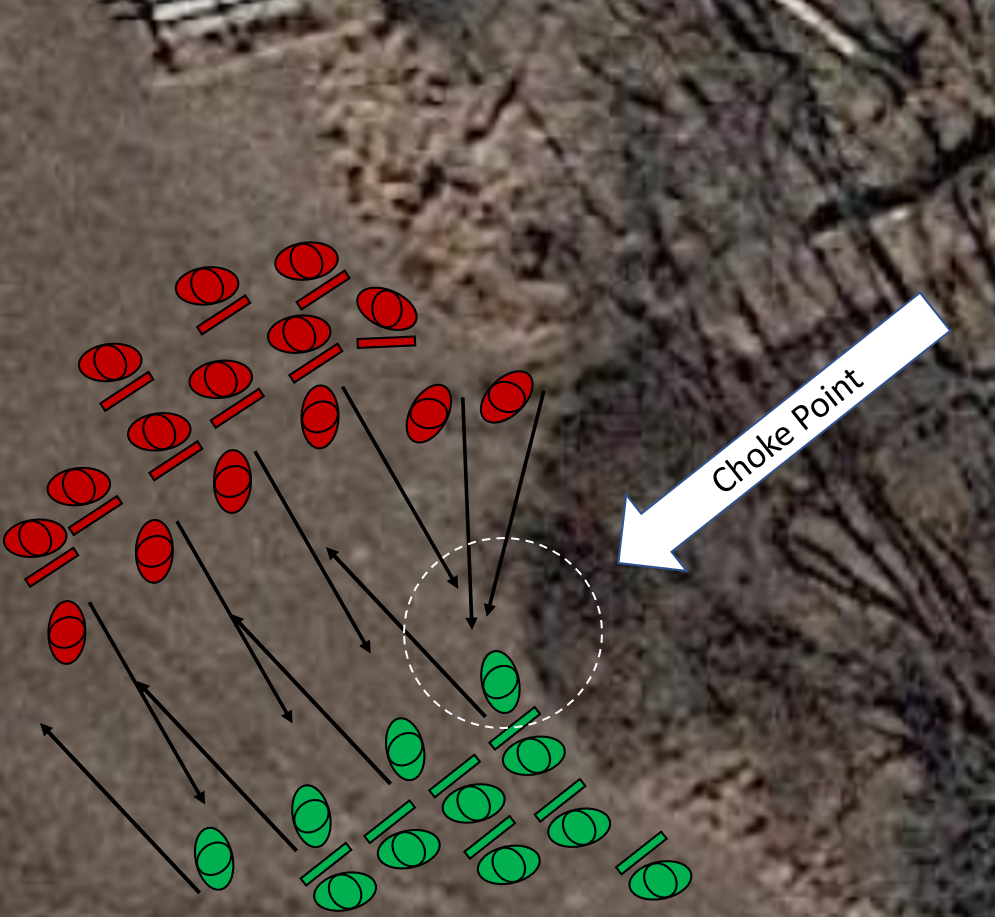
- A choke point between brambles and a picnic table exists roughly halfway between the two rez points
- The hill peaks roughly half way between the two rez points 
- A mud pit forms where most of the fighting takes place (not a bad one, but enough to significantly affect footwork).

In an ideal situation, you would want to fight with your enemy in the choke point, and your team fighting in a more open section (this creates kill pockets on either side of the choke point that your opponent has to fight through), fight uphill from your enemy, fight closer to your rez point than they are to theirs, and fight so that your spears are standing on grass and their spears are standing in mud (this will change as the day moves on).


In the pic above you can see the disadvantage a team has when fighting from inside of a choke point.  (Fighters not drawn to scale)


Fight Through Choke Point or Give Up the High Ground?

Looking at the pictures above, the peak of the hill sat just to the right of the choke point.  So either side was going to either fight with the uphill advantage, but trapped in a choke point, or outside of a choke point, but on the downhill side, unless of course the uphill team could push through the choke point toward the left rez point. 

The choices here (for the right team) are either to attempt to push through the choke point, or to give up the high ground.  I fought on the yellow team, which fought on the right side (according to the pictures) for the first 50 minutes.  I had floated around the battle fighting on the left flank, right flank, and the middle as well.  On both flanks we had attempted to mount charges through the kill pockets, hoping to break through the choke points.  In fact, I had noticed several occasions where our opponents had no support behind their spears, which would be an ideal situation to charge through and turn the corner.  Not only would that get us out of the choke point, but also create a kill pocket of our own, and possibly mop up an entire flank and score a lot of points.

Pictured below is an illustration of how we attempted to break through the choke point when we saw there was no backup for their spears (we are represented by green in the picture).


Did it Work?

Nope.


Why Not?

For a few reasons.

1 - Choke points are hard to break through as the opposing kill pocket puts more numbers on our shields that are trying to charge through.

2 - There was a level competency that the other team had that allowed them to cover the hole before we could push through.  In fact, when in the opposite situation, I was once returning from rez and I head Duke Edward yell "Bari, left!  Bari, left!"  I looked left, saw the column attempting to break through our flank, and ran over to add support.  Both teams had more than enough veteran fighters who could recognize and plug a hole relatively quickly.

3 - Even if we did break through, it would have put us closer to the other side's rez point, which allows them to replenish the ranks more quickly.

None of this is to say that it wasn't a good idea.  In many instances it would have worked.  We just couldn't manage to get it to work, on either flank.


If You Can't Break Through, Should You Keep Charging?

That depends.  Are we trying to win?

I'm actually not being sarcastic.  100 Minute War is a really fun battle with lots of action.  It's also a great place to practice charges and counter charges, as well as command.  This is a difficult concept for a lot of fighters to understand, but winning is not necessarily the only goal.  I do think that battles flow better provided that there is at least some sort of winning objective to work toward.  I like having a reason to rack up kills while trying to stay alive.  I knew that running to the left when Duke Edward yelled at me was going to help us move closer toward a winning condition.  But it is sometimes just as important, if not more important, to train and make sure that everyone is having fun.

Several years ago I analyzed some drone footage of 100 Minutes War and counted up the deaths after every charge.  The charging team almost always lost more lives than the team receiving the charge.  I'd also analyzed similar footage of an Allied Champions Battle at Pennsic with the same result.  All else being equal, assuming that both sides are of at least average competence, the charging team seems to lose more lives if charging without a clear advantage.  Charges really need to occur when there is a clear advantage to doing so (ie charging into spears and archers, into a retreating opponent, into a flank, into a lesser skilled opponent, into a smaller unit, etc.)

Again, that is if your goal is solely to win.  That's my goal in an Allied Champions Battle on the first day of Pennsic.  That is less of a goal of mine in the last battle of the season before the holidays.

And I want to reiterate, that doesn't mean I'm opposed to charges.  I recommended some to commanders myself.  It's just that they are sometimes difficult to pull them off with success, and everyone needs to try to read those results as they occur on the battlefield and then make adjustments.


Improved Command for the Second Half

Someone had recognized a breakdown in command in the first half of the battle.  No one really new who was responsible for battlefield decisions, and that can be problematic at times.  In the second half, three commanders were appointed to control the left, right, and middle.  If anything, it gives an executive decision maker to run recommendations through.  I don't personally like to command, but I do see a lot of things on the field and like to know who to run those observations up to.  

Having said that, we had a strategy in the second half that involved staying out of the mud and out of the choke point.  It appeared that the opposing team had the same strategy, so neither side engaged at first.  Thank the heavens that both sides, more or less, came together in the middle.  I've seen battles where both sides care so much about winning that they will both refuse to engage.  Those battles sucked!  We can still meet in the middle, have a good fight, while both sides attempt to draw their opponents into the kill pockets throughout the fight.  You are still applying good tactics while enjoying the fight.


Stick With a Unit or Float?

Most people like to stick with their unit.  They often fight better with people they're used to, it's a good way to build unit cohesion over the years, and it's a good way to organize a front line so that no holes develop (ie this unit here, that unit there, this other unit over yonder, etc.)

I'm more of a floater.  I tend to see opportunities and act on them.  I'm also a veteran with a bit of a reputation, and if I stick to any one spot, people start figuring out ways to beat me (matching me with someone who knows my tricks, putting an archer on me, doubling up, etc.).  I also like moving around the front to evaluate the battle and see if there's anything that I can report up through our command structure.  Now, if I'm at Pennsic with a unit of 30 fighters, I will always stay within proximity of that unit, rather than float all over the battlefield, but in a battle like this I will float around a bit more.

Having said that, I mostly look for spots in our line where we are weak on spears.  Usually it will be a spot where two or three shields are on the front line.  I walk up behind them and ask if I can have one of their spots, and they usually allow me in front of them.

Note:  regardless of who you are, if someone has you figured out and they keep killing you, whether its a spear god, or an archer, or someone who just has a really good angle on you, it's probably a good idea not to keep returning to the exact same position.  

Below is an example of a position I might want to move into.


In that example, I would likely put my spear between the two shields and say, "spear coming up.  Would you mind if I take your position for while."  They almost always will give up their position to let me fight.


Calibration

Calibration varied at the event.  There were periods when it was high (meaning that people required a very hard shot to accept as a kill) and periods where it was lower, usually after Sir Tanaka had stepped in and asked everyone to lower their calibration.

I'd like to talk about this for a bit because I believe there is often a misunderstanding about how calibration is or should be determined, and not everyone reading this will agree with me.

Calibration varies.  Some people think that it shouldn't, but it simply does.  And it does because it has to given that we have a variety of levels of fighters, many of whom drive hours and hours to events, and some events tend to have a greater focus on inclusion rather than elite competition.

Consider this:  many fighters don't have the power generation mechanics to land a "telling blow" that would typically be accepted in a very competitive tournament in some kingdoms.  In fact, it's entirely possible that this could represent as many as 1/3 or even 1/2 of the heavy fighters in a kingdom.  Do we tell them, "you will never land a kill in any event, ever, for several years until you improve your stick mechanics?"  What if two of these fighters see each other in a tournament?  How long do you let the two of them fight before someone steps in and says, "neither one of you can land a telling blow and it's beginning to get dark, so lets flip a coin?"  And even if they accept the fact that they just aren't going to score kills, are they going to enjoy getting pounded on all day by really heavy blows?

This tends to make a lot of people angry and drives away a lot of fighters.  What also makes fighters especially angry is when 99% of the fighters at the event are fighting at, lets say, a medium calibration level, while a small number have determined that they are just going to stick with the same level of calibration you might expect from everyone at a highly competitive tournament.  While I think it's reasonable to have some events where high calibration is expected, the nature of our sport makes it difficult to carry that same level of calibration 100% of the time.

Having said all of that, I don't believe high levels of calibration are normally the result of deliberate cheating.  Duke Edward once told me that a fight is a really a "conversation" where you hope that the two fighters involved can come to an agreement on whether or not a telling blow was scored.  Sometimes a pair of fighters just aren't on the same page when it comes to calibration, and they failed at having that figurative conversation.

Normally in a friendly unlimited resurrection battle with a couple 100 fighters, calibration tends to be on the medium side of things.  In the first 15 minutes of this 100 Minutes War, it was very high.  In my personal opinion, I think people were so amped up on adrenaline as a result of fighting their first big battle in two years, that they were swinging hard and really didn't want to die.  I can fight this way if I have to, but I don't like it for these kinds of battles for a few reasons.  I have to wind up more and step into my shots more to deliver telling blows, which means they are telegraphed more, which means they land less frequently.  I am also more open when I throw these shots, which means I get hit more.  Many of the shots that I'm hit with I won't need to take because calibration is high, but not everyone will agree with this, so people will get angry at me because they think I'm cheating.  Some people get annoyed because they can't kill anyone.  And some people get hurt because I don't know who is armored up and who isn't, and I end up throwing hard at everyone.

Sir Tanaka read the emotions on the battlefield  and stepped in and asked us all to lower our calibration.  Calibration may not have been "above the rules," and it may not have been too high for Crown Tourney, but he determined that it was too high for the fun and safety of the event.  I did mention to him that calibration issues can't be solved simply by asking people to throw lighter shots.  I said, "People aren't taking my lighter shots, so I'm really turning up the power.  We need to both throw lighter AND take lighter," and he echoed that sentiment to the group.

It did seem that calibration came down immediately.  Ultimately it seemed to creep up again, and he stopped the fighting and addressed it again.


Until Next Time

Hope you enjoyed this post.  Time to heal up over the winter and come out fresh and ready in the spring!


Bari of Anglesey

Photo credit:  Joshua Gershon Feldman


Monday, November 15, 2021

Broken Field Battles - PAL Practice - Massachusetts

 Hi all,

Just returned from a fantastic weekend of fighting with a good prep for 100 Minutes War next week.  I'd heard many great things about this practice and am glad that a small crew of us was able to make the 6 hour drive to get there.  

If you're new to reading this blog, this post marks my 109th post over a 6 year period, and is more or less my reflections over what went well, or what could have been improved in a particular practice or event.

So let's get to it.

Scenario #1:  7v7 Two Rez (three lives) Broken Field Battles

I believe we had 28 fighters which were broken up into four teams of 7.  Two teams fought each other while the other two teams watched.  After the battle was over, a new pairing would take the field and fight.


Decide Which Weapons to Bring

For our team, the very first tactical decision we had to make involved a collective assessment of the talents and weapon types on our teams versus our opponents.  We then had to consider how such a battle would pan out.  In a nutshell, the longer it takes to complete a battle, the more and more advantage goes toward having more spears on your team.  The shorter the battle, the advantage tends to lean toward more shields.

The reason behind this is that in order for a shield fighter to kill a spear fighter, they must charge.  Charging is very exhausting, and longer battles require more charging, which makes the shield fighters more tired, which makes them have to take more breaks, and taking breaks between the charges gives all the advantages to the ones with the spears (I can poke at you without fear of being run down).

Having said that, there is a balance point.  A team made up of 7 spears and no shields would have a tough time killing any of the shields as they would likely get mopped up in each wave of charges.

We ultimately decided to bring out three spears, and I believe every other team brought out either two or three spears (in a single death battle, you might see zero spears).


Field Area Responsibilities

The next decision, aside from picking a commander and a reform call ("two" was our call......despite the fact that we were team #4), was to decide who would go where.  I am a very big fan of controlling areas rather than some sort of buddy system where people decide to always fight together in pairs or triads.  "Buddies" is good for very new fighters in an overwhelming situation, like Pennsic.  But for fighters with experience, I'd rather them understand that their job is to "work the left side of the field" rather than, "Go find Larry."  

This doesn't mean that you shouldn't conceptualize the idea of a shield working with a spear (or two shields and a spear), but that a shield on the right side of the field should work with a spear on the right side of the field, and it might be a different spear than it was a minute ago.  Also, just because your role was to work the right side of the field, that doesn't mean that you can't shift your attention to the middle or the left if there's an immediate tactical need to do so.   For example, if you have a 3v1 advantage on the right, and the 1 is really good at retreating, and you see an easy oblique kill that can be made in the center, it may be a good idea to leave your area to go get the easy kill, provided that you understand that you need to keep an eye on the right side and return to it when needed.


We decided on a balanced approach with a left spear, center spear, and right spear, and then spread the shields out the same way.  I'm a big fan of having your best shields control the flanks with a notable exception that I'll talk about later.  We spread out the shields the same way;  left, center, right, and then allowed our pole to float to where ever he felt he needed to be.


Smart Kills, Don't Die

The tactics in this kind of battle are basically to die as little as possible while getting as many kills as possible.  This happens by finding good matchups and exploiting your advantages.  Better spears should attack weaker spears.  Weaker spears should be defensive.  Attack on the 2v1s, stall on the 1v2s.  Look for oblique attacks.  Pull back toward your rez point if you're outnumbered.  Use the terrain features to lure them into kill pockets.  

In our fights, we let the spears do most of the killing.  If the other side charged, the spears would run to safety while the shields and pole would run in to protect them.  Shield charges should generally occur only when the shields are confident that the net result will be more kills for their team.  Charging at a spear only to get clubbed by a pole is not a good decision.  

Note:  When a spear runs for safety, they need to immediately get back into the fight.  Don't run away and wait for things to clear out, but rather find a way to get yourself back into the fight.


Proximity to Rez Point

In an attrition battle, normally it is to your advantage to fight near your rez point and away from your opponent's.  Does that mean that you should just wait at your rez point and let them come to you?  If they aren't very smart, they may do just that.  However, more often than not, neither side will get too far away from their own rez point in these kinds of battles, and thus most of the fighting occurs somewhere in the middle of the field.  What this means for you is that one of the easiest ways to survive a fight when the other team has the advantage is to simply back up toward your own rez point (calling your teammates to come along with you).  

The reason why this gives you an advantage is that every kill that your team gets is a long walk for your opponent, and every kill they get is a short walk for your teammate.  This means that you will replenish your ranks much faster than they will.  

Having said that, if you are counting kills, it may be to your advantage to finish off your opponent near their rez point, but then you must immediately retreat back to the center of the field.


Scenario #2:  14v14 Unlimited Rez Broken Field Control Point Battles

Very similar fights to above, except now we have twice as many fighters on a similarly sized field, and the objective is to control the center of the field instead of attrition.  The battles were 5 minutes long, and a handful of points were scored at intervals within those 5 minutes based on which team had the center controlled.

One piece I particularly liked was that we combined the teams from the previous scenarios, and then switched them for the second half of these battles.  So at one point is was Teams 1&4 vs 2&3, and then later 1&3 vs 2&4 (or something like that).  That offered a little bit of variety in the fighting so that you didn't end up fighting across from the same people all day.  


Tactical Differences

Many of the same tactics as the previous scenario apply:  choosing weapons and where they go, picking a commander and a team name, getting kills while trying to survive, trying not to fight near their rez point while walking back toward your own rez point for safety, etc.

There were some key differences, however.  Since the objective of the battle is to control the center of the field, killing is no longer important except that it helps you move the line of engagement past the center of the field so that you can take control of it.  Also, because the numbers were so much greater, echoing commands becomes more and more important as someone yelling from the left side of the field likely won't be heard nor recognized from the right side of the field.

I had mentioned before that I prefer the best shield fighters to be on the flanks, as controlling flanks is critical in a melee.  In this scenario, however, one or more good shield fighters also need to be in the center in order to take and defend the objective.


Don't Fight at Their Rez Point

I pointed out above about the disadvantage of being far from your own rez point.  This is even more pronounced in this scenario because a kill is literally worthless if it doesn't lead toward moving the line of engagement forward.  If you are already at their rez point, there's nowhere left to go.  Every kill is immediately replenished with a short walk.  

Here's an example of the team from the right side of the camera pushing the line up to the rez point, and then calling a charge while already controlling the center point.  

Watch @0:45

PAL Video 3

Notice that a charge is initiated by the team on the right which pushes the left team all the way back to their rez point.  Once the charge is resolved, the left team is at full strength, while the right team only has one fighter left alive.  The left team then easily walked the line forward and took control of the field.

Given the set up of the field, there was never a reason to push beyond the choke point, which is a terrain feature that offers the best defense.


Edit to add:  Upon further review, I noticed that the charge was against a line of 4 spears, which put the right team in a bit of a predicament.  Normally you'd want to charge that, but the left team had backup to their left since they were beyond the obstacle, and even if they didn't, they were close to their rez point.  I still think a charge here is the wrong call (as evidenced by the result) but can certainly understand why that call was made.


Echo Commands

I remember one scenario where our left had pushed too far toward toward the rez point, and I kept yelling "Left flank, pull back!"  At one point I yelled, "what's our team name?!"

So a few problems here.  One was my fault.  I didn't know what our team name was.  One was probably the fault of everyone which was that I don't think many of us knew what our team name was.  One was the left flank pushing too far.  And finally one was that even though the left flank couldn't hear me, some people on our team could but didn't echo the commands.


Rolling a Flank When You Have the Advantage

In the same video, you hear the left team say, "roll that flank!"  What this means is that you aren't necessarily focussed on killing the enemy, but rather continuing to press forward while walking them backward, and curling the flank around in the process. 

Watch @0:55

PAL Video 3

Notice he says the command at least 4 times.  Some of the fighters turn to kill the fighters holding the control point, while the rest walk past and take control of the flank.  Not only does this move the line of engagement beyond the control point, but it also creates a kill pocket which gives a big advantage to the left team.  Also notice that even though they had a huge numbers advantage, they stopped pressing at the choke point.


Some Techniques to Rolling a Flank

There were several instances in the smaller battles where we'd have a 2v2 competitive spear battle on one side of the field.  Whenever one of their spears would get killed, I'd immediately tell my partner to start rolling the flank.  To do this, I would go on full defense against the spear, trying to pin his shaft so that he can't shoot at either one of us, and then start walking forward, ideally past his tip, to continue to get him to either a) die from a spear shot from my partner or b) keep walking backward so that we can take the flank.

In a control point scenario, this helps us move the line past the point.  In an attrition battle, it forms a kill pocket to allow the other spear either an easy kill on the one I'm tying up, or an easy kill on someone in the pocket.


Another technique involves getting a shield past the tip of the spear on the flank.  If the shield fighter is right handed, it would be on his or her far right flank.  Reverse that for a lefty.  

There's an example of this in the foreground of the following video.  The lefty shield initiates a charge and gets his shield into a position where he protects himself from the two spears on the flank.  For what it's worth, I'm always a big fan of having your shield either take the extreme flank position (as he is) or at a minimum be the second to last fighter on the flank.

Watch @0:28

PAL Video 3


I should probably say that it was Sir Sterling who initiated the charge, but the lefty was the key component to the success of that charge as he was in the perfect position for it.  Unfortunately, I think the backup shield got in a step too late as she was returning from rez point and took the first available spot as the spears ended up crowding on the flank.  Either way, the right team had a clear tactical advantage in this push.  

I should also note that in a 4v4, the team with one spear should normally charge the team with three spears, so good call on their part.  Also good on the three spear team to retreat and stay alive rather than to die trying to hold a position that they can't hold.


Commands Have to be Spoken in a Manner that Coordinates the Plan

There were some instances where commands were called to take the point.  Now, it's not a bad idea to yell, "c'mon, move forward and take the control point."  But understand the only thing this accomplishes is hoping that someone else will call out the command.

The problem with "everyone move forward," is that no one is going to move forward until they believe that everyone else is going to move forward with them.  A better command is, "Blue team, get ready to move two steps forward to take the objective.  That's two steps together.  Ready?  Step!  Step!"  

I gave a similar command to Gui on the far right flank.  I saw three spears with no shields and knew that if he was on the far right position (the opposite of the lefty pictured above) that he could move the whole line back.  I said in a tone that only he could hear, "They have no shields.  Get ready to charge.  You got that?"  "Yes."  "Okay....ready......go! go! go! go!."  And when he did that, I was sure to parry any spears that would turn toward him for side and leg shots.

Having said that, my yelling, "left flank," over and over again didn't accomplish anything.  Who's left flank?  And what are they supposed to do? 


Final Thoughts

I can't stress how much I enjoyed this practice and how well run I thought it was.  I've always been a critic of the "commanders lead, troops follow," approach.  By contrast, this practice encourages everyone to take as much ownership in the on field decisions as they are willing to take on, which has always been a philosophy of mine.  If you train someone to know what to do, then you won't have to tell them what to do.

I'd also like to apologize for sounding like I'm calling anyone out for any mistakes.  Every single fighter of every level makes mistakes at some point in the battle, including myself (didn't even know our own team name.).  We're rusty, we're constantly changing teams, we're tired, and not everyone can know every perfect decision to make in every moment of a battle.

Anyway, hope you enjoyed this write up.  Talk to you soon!


Video Links

PAL Video 1

PAL Video 2


PAL Video 3


-Bari of Anglesey